Artificial intelligence is changing the workplace, but the future of work may not be as simple as AI replacing people. Instead, it may be about people learning how to work alongside technology while developing the skills that technology cannot easily replicate. As AI becomes increasingly integrated into professional environments, the value of an employee may depend less on whether they can complete a task without technology and more on whether they know how to use technology effectively while still contributing judgment, creativity, communication, and human understanding.
At a recent Hofstra University panel, “The Future of Work: Augmented Professionals: Blending AI Capabilities With Human Judgment in Business Careers,” industry and academic professionals discussed how artificial intelligence is already changing jobs, what employers are looking for in new graduates, and how students can prepare for a workforce that continues to evolve.
The panel featured Ebony David, Vice President for Human Resources at Quest Diagnostics; Patrick Holton, Executive Director of Zarb Graduate Career Services; Sai Radhakrishna Palepu, Assistant Professor in the Department of Finance; and Danny Pellegriti, Head of Strategic Partnerships and Business Development at Google Beam. Lauren Hindman, PhD, Assistant Professor in the Department of Management and Entrepreneurship, moderated the discussion.
What stood out to me most was that the panel did not frame the future as a competition between humans and machines. Instead, the speakers repeatedly returned to the idea of augmentation: AI can change how people work, but humans still determine how that technology is used. This perspective is reflected in a recent Forbes conversation about AI and the future of work with IBM Chief Human Resources Officer Nickle LaMoreaux, which argues that the impact of AI depends partly on whether organizations use it to replace workers or redesign work around human capabilities.
The panel therefore raised a more interesting question than “Will AI take our jobs?” It asked what our jobs will look like when AI becomes part of them.
AI Skills Are Becoming Part of Professional Skills
One of the clearest takeaways from the panel was that AI skills are becoming increasingly relevant across post-graduate careers. For entry-level employees, knowing how to identify appropriate AI tools, use them effectively, and develop strong prompts can become an important part of entering the workforce.
However, knowing how to use AI is different from knowing when to use it.
Patrick Holton discussed how career services at Hofstra has begun incorporating AI into its work with students, including using it to help revise essays and applications. AI can identify grammar issues, improve organization, and make a document easier to read, but the final product still needs to represent the person applying. Holton emphasized the importance of keeping the process “humanized.”
This distinction is becoming increasingly important because AI is making some traditional application skills easier to reproduce. Correct grammar, polished formatting, and a well-organized paragraph are no longer necessarily evidence that an applicant completed those tasks independently.
That does not make those skills irrelevant. Instead, it changes what employers need to look for.
A recent MIT Initiative on the Digital Economy analysis of AI and the future of work argues that automation should not be viewed as a simple switch between “human” and “machine.” MIT researchers describe a spectrum that includes no automation, partial automation, and full automation. Their research suggests that partial automation may become particularly important because AI can perform certain components of a task while humans remain responsible for the rest.
That idea closely reflects what the Hofstra panelists described. AI does not necessarily have to perform an entire job to change that job. It only needs to change enough of the individual tasks to alter how the employee spends their time.
“They Still Do the Work, It’s Just Different Work”
This idea became especially clear when the panelists discussed how technology has changed their own careers.
Ebony David described the transformation in healthcare by saying, “They still do the work, it’s just different work.” She explained that technology has improved turnaround time and allowed medical professionals to focus their attention on responsibilities that require their expertise. She summarized her own experience by saying, “It changed every aspect of what I do, and I love it.”
Her comment challenges the assumption that technological advancement automatically means fewer meaningful responsibilities for humans. Instead, technology can redistribute those responsibilities.
This distinction is important when discussing employment because a task is not the same thing as an occupation. A job can remain necessary even when some of its individual tasks become automated.
The MIT research supports this more complicated understanding of automation. Its researchers argue that the workforce impact of AI will vary depending on the complexity of a task, its cost, and how much of the task can realistically be automated. In other words, the fact that AI can perform part of a job does not automatically mean that an entire position disappears.
The Washington Post’s interactive analysis of AI and real-world work assignments provides another useful example. The analysis compared AI systems with humans completing hundreds of actual work assignments and found that although AI can perform impressive tasks, it can also produce results that look convincing while containing significant errors.
This reinforces one of the panel’s most important messages: AI can change the work without necessarily replacing the worker.
The more important question becomes what the worker does after the technology completes its portion.
The Human Skills AI Cannot Easily Reproduce
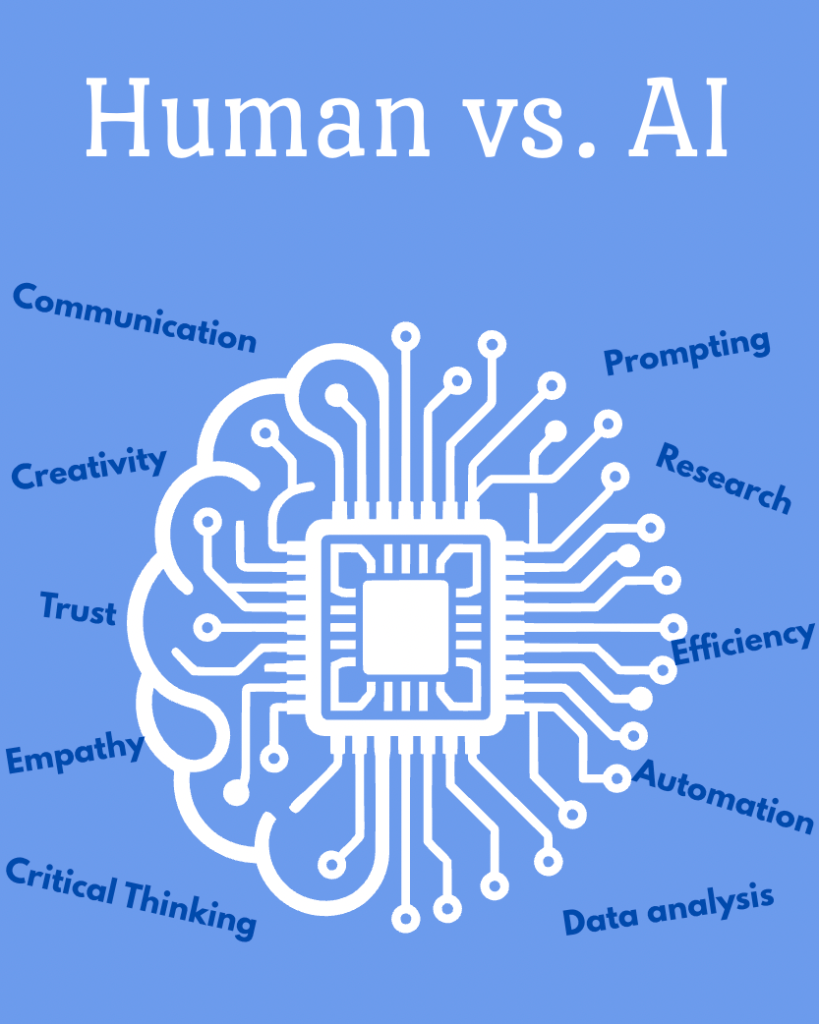
While AI skills are becoming more important, the panelists repeatedly emphasized that human skills are not becoming less valuable.
In fact, they suggested that some human abilities may become more important precisely because AI is becoming more capable.
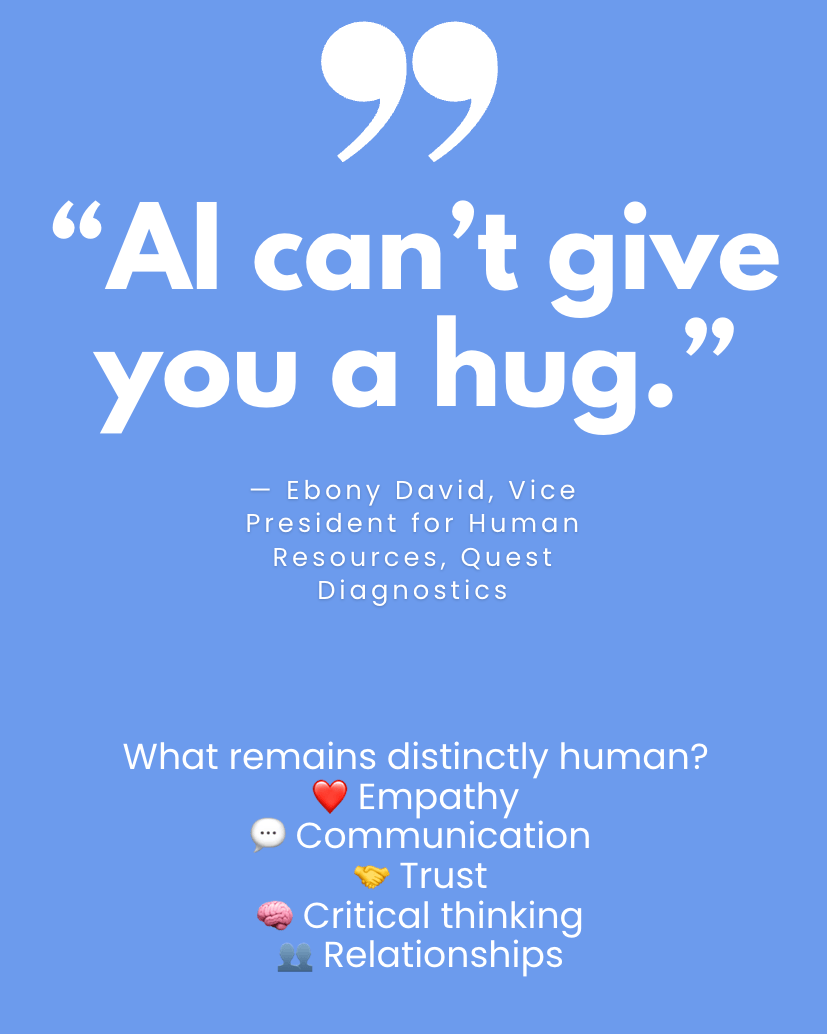
David emphasized empathy and emotional understanding, explaining that “AI can’t give you a hug.” It was one of the most memorable comments from the panel, but it also captured a serious point. AI can generate language that sounds empathetic, but professional relationships still involve trust, emotion, personal experience, and human connection.
Sai Palepu similarly emphasized critical thinking and trust, particularly in finance. He pointed to the continued importance of in-person financial advisors because clients still want human interaction when discussing something as personal and consequential as their portfolios.
Pellegriti made a similar argument about sales and business development. He emphasized acting with urgency, responding quickly, and being helpful. He argued that successful selling still depends heavily on human connection and understanding another person’s needs.
These observations connect to a broader conversation about reskilling. A Wall Street Journal report on growing concerns about AI-related job disruption and the need for reskilling highlights the urgency of preparing workers for technological change. The issue is therefore not simply whether employees know how to use new software. They also need the communication, adaptability, and problem-solving abilities that allow them to function effectively as their responsibilities change.
The combination matters.
An employee who understands AI but cannot communicate with a client may struggle to turn the technology into meaningful results. At the same time, an excellent communicator who refuses to understand emerging technology may find it increasingly difficult to adapt.
The future professional may need to be both.
Being AI-Informed Is Different From Being AI-Dependent
Another point from the panel that I found especially important was the distinction between being AI-informed and being AI-dependent.
David emphasized that students need to know when AI is wrong. She shared an example of a first-year analyst who used AI to complete a task but did not know how to go back and fix the work when the technology produced an incorrect result.
The problem was not necessarily that the analyst used AI. The problem was that they did not understand the work well enough to evaluate the output.
This is where critical thinking becomes an increasingly important professional skill.
The New York Times has similarly examined how AI is changing the workplace, particularly the tension between AI’s ability to automate tasks and the continued need for human workers to oversee, interpret, and improve those tasks.
AI can produce an answer very quickly, but speed does not guarantee accuracy.
The Washington Post’s research comparing AI with human performance demonstrates this problem visually. Some AI-generated projects initially appear successful but contain errors that become obvious when examined more closely.
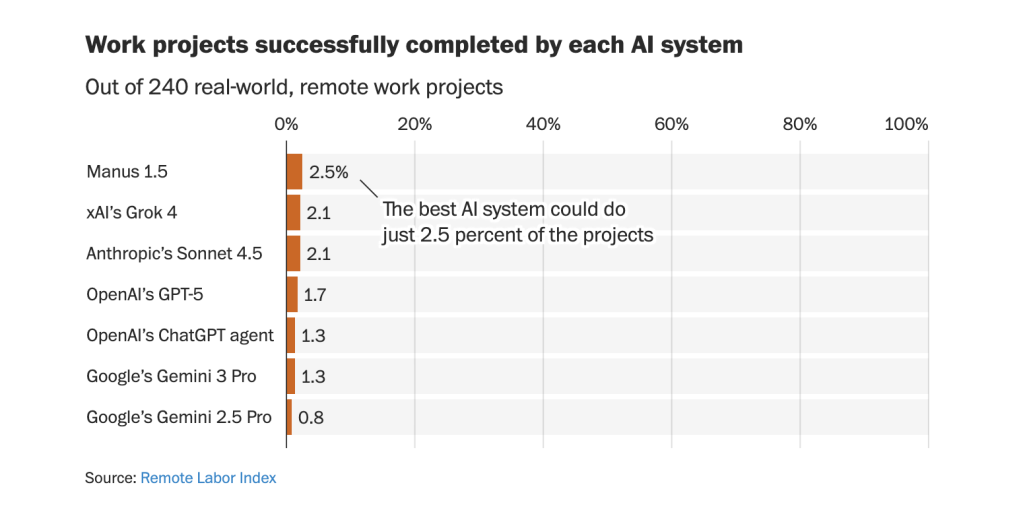
Image from The Washington Post created using https://www.remotelabor.ai/
This makes the panel’s message particularly relevant for college students. We should not simply learn how to ask AI for an answer. We should learn enough about our fields to recognize when that answer is incomplete, inaccurate, or inappropriate.
The strongest AI user may therefore not be the person who can write the most sophisticated prompt.
It may be the person who knows when the answer is wrong.
The Job Search Is Changing, Too
The panel also addressed how AI is changing the process of finding a job.
Patrick Holton pointed out that applying for jobs is becoming easier because technology allows students to submit applications more quickly. However, this creates another problem: employers are receiving an enormous number of applications.
If AI makes it easier for candidates to apply, simply clicking “apply” becomes less meaningful.
Holton encouraged students to be more intentional about their applications and to clearly demonstrate how they have used their skills. Instead of simply putting “AI” on a résumé, students should explain what they did with the skill, how they used it, and what resulted from it.
That distinction matters.
“Proficient in AI” tells an employer very little.
“Used generative AI to accelerate research while independently verifying information and editing the final material” communicates a process and demonstrates judgment.
The panel’s advice was therefore not to hide AI experience. It was to make that experience meaningful.
David also encouraged students to use AI strategically during the job search, including asking questions about how they can stand out to employers and what questions they should ask during interviews.
At the same time, she emphasized something technology cannot replace: talking to people.
She encouraged students to schedule short 15-minute conversations with professionals and to take interviews even when the position is not exactly what they expected. A conversation can reveal an industry, position, or career path that a student had never considered.
That advice connects directly to another point made by Patrick: the importance of learning how to network, give an elevator pitch, and have genuine conversations.
Stop Focusing Only on Job Titles
One of the panel’s most useful pieces of advice was to become more flexible when thinking about career opportunities.
David encouraged students not to become overly specific in their job searches. As technology changes industries, job titles and responsibilities can change with them. Instead of worrying exclusively about finding a particular title, students should pay attention to the content of the work and the skills they will develop.
That idea is especially relevant as companies themselves change.
A recent article examining Google’s transition toward becoming increasingly centered on AI illustrates how technological shifts can change even established companies. Google’s business has expanded far beyond its original search function, and AI is now influencing the company’s technological direction and priorities.
For students, this means that preparing for the future cannot mean preparing for one fixed version of the workplace.
The jobs available ten years from now may not have the same titles as the jobs available today.
What may remain valuable are the abilities to learn, communicate, think critically, adapt, and work with technology.
Preparing for a Workforce That Is Still Being Defined
The future of work is difficult to predict because AI itself continues to develop. The evidence available today does not support a simple conclusion that AI will either eliminate employment or leave the workforce unchanged.
A recent Washington Post report on AI and recent college graduates examined early labor-market data for the 2026 graduating class. The article reports that researchers found no statistically significant increase in unemployment among recent graduates in occupations considered vulnerable to AI, although the researchers emphasize that these are early findings and do not eliminate concerns about longer-term effects.
That uncertainty makes the panel’s message especially relevant.
Students do not need to know exactly what the workforce will look like. They need to be prepared to adapt when it changes.
For me, the most important lesson from the panel was that preparing for an AI-driven workforce is not about choosing between technology and humanity. It is about learning how to combine them.
AI can organize information, generate ideas, improve efficiency, and assist with repetitive tasks. But humans still have to ask the right questions, evaluate the answers, communicate with other people, build trust, and take responsibility for the final outcome.
As David emphasized, students need to be open to the possibilities. There are new platforms, new technologies, and new job titles emerging constantly. Rather than becoming overwhelmed by that uncertainty, students can use it as a reason to develop a broader skill set.
The future of work may ultimately belong to professionals who are neither completely dependent on AI nor resistant to it. It may belong to people who understand its capabilities while recognizing its limitations.
The goal is not to compete with AI at being a machine. It is to become a better professional who knows how, when, and why to use one.
References & Further Reading
- Carvão, Paulo. “How AI Is Redefining the Future of Work: A Chief HR Officer Conversation.” Forbes, 2025.
- “AI Job Fears Grow; Tech Leaders Say Reskilling Can’t Wait.” The Wall Street Journal.
- “AI, Jobs and Work.” The New York Times, 2023.
- MIT Initiative on the Digital Economy. “How Much Will AI Impact Tomorrow’s Workforce? New Data on the Future of Work With AI.” MIT Sloan School of Management, 2026.
- Waldvogel, Miriam. “Is AI Killing Jobs for College Grads? Not Yet, New Study Says.” The Washington Post, 2026.
- Schaul, Kevin. “Can AI Do Your Job? See the Results From Hundreds of Tests.” The Washington Post, 2026.
- “Google at 28: The Search Company Is Becoming an AI Company.” The FINANCIAL, 2026.
- [“The Future of Work: Augmented Professionals: Blending AI Capabilities With Human Judgment in Business Careers.” Hofstra University panel discussion. 2026.]







Leave a Reply