Buy now, pay later has changed the psychology of shopping for women’s fashion. Here is what Klarna, Revolve, researchers, and regulators reveal about the real price of paying in four.
Fashion has always sold possibilities. A dress is rarely presented as just fabric and stitching; it is the wedding-guest entrance, the vacation photograph, or the version of yourself who has somewhere exciting to be. Buy now, pay later (BNPL) adds another layer to that fantasy: the $240 dress can appear at checkout as four payments of $60.
The dress has not become cheaper. Its price has simply been reframed. Leading to accidental consumer overspending.
That distinction matters in women’s apparel, where rapid trend cycles, frequent new arrivals, influencer recommendations, and occasion-based shopping already create urgency. BNPL can be genuinely useful when a shopper has planned a purchase and knows that four payments fit her budget. It can also make an unaffordable item feel temporarily affordable by directing attention toward the first installment instead of the total obligation.
The central question, then, is not whether BNPL is “good” or “bad.” It is whether the convenience serves your budget—or persuades you to stretch it.
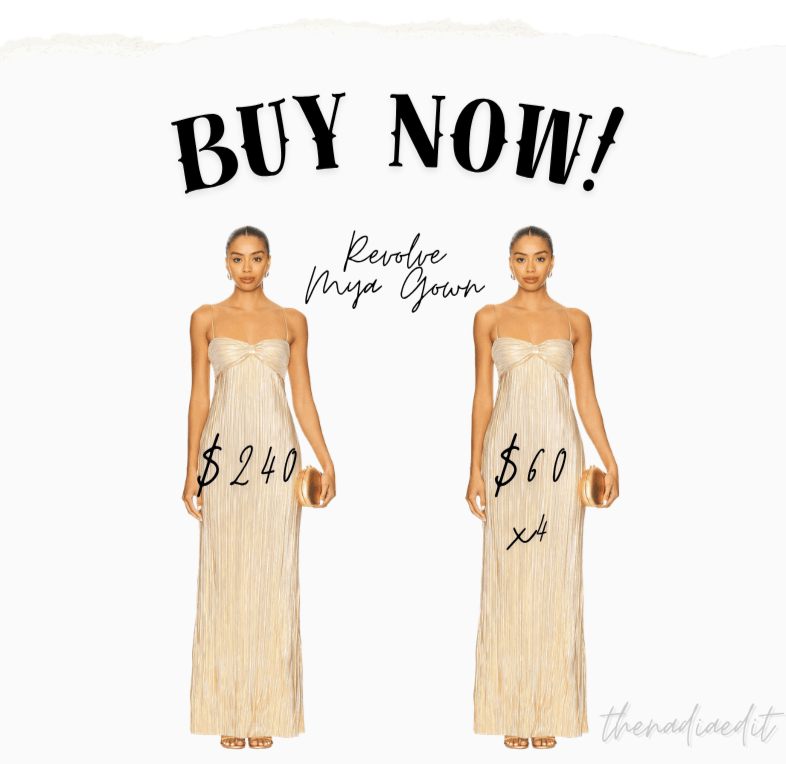
Revolve Mya Gown, Same Dress Two Different Ways to Look at the Price
What “Pay in 4” Actually Means
BNPL is a form of point-of-sale credit. Instead of paying a retailer the entire amount at checkout, the shopper agrees to repay a third-party lender according to a schedule. The classic “pay in four” structure divides the total into four equal installments, commonly with the first payment due immediately and the remaining payments collected every two weeks.
The word interest-free can make this sound almost consequence-free, but the obligation is still a loan. The Federal Reserve’s 2026 overview emphasizes that modern BNPL is broader than one simple product. Providers now offer short- and longer-term installment loans as well as pay-in-four plans; some carry 0% annual percentage rates, while others charge interest. The Fed estimated that major providers originated close to $160 billion in BNPL credit in 2025, with pay-in-four accounting for about half.
For a fashion purchase, the math can look effortless:
- Dress price: $240
- Due today: $60
- Three later payments: $60 each
- Total before any possible fees: $240
The smaller figure is not false. It is incomplete when viewed alone. Your budget must absorb the full $240, even though the checkout design encourages you to think first about $60.
Why Installments Change the Way a Price Feels
BNPL does more than move payment dates. It changes the mental experience of spending.
In a 2025 Journal of Retailing study, Ashby, Sharifi, Yao, and Ang found that presenting a purchase through installment prices lowers consumers’ perception of how expensive it is, which can increase spending. This is a framing effect: $240 and “four payments of $60” describe the same total cost, but they do not necessarily produce the same emotional response. ,
A separate Journal of Retailing study by Kumar, Salo, and Bezawada estimated that customers increased their online spending by approximately 6.42% after adopting BNPL. That figure does not prove that every shopper will spend 6.42% more, nor does it mean every additional purchase is irresponsible. It does show why retailers value the payment method: reducing the immediate “pain” of payment can increase what customers are willing to place in their carts.
For consumers, this is the most important insight. BNPL’s power is not limited to affordability; it also operates through perception. If a product becomes attractive only after the price is divided, the installments may be influencing the decision rather than merely facilitating it.
Revolve, Klarna, and the Fashion Checkout
Revolve is a revealing case because its retail environment is built around discovery: trending labels, party dresses, shoes, accessories, influencer-led styling, and a constant sense of what is new. The platform lists several third-party payment methods, including Klarna and Cash App Afterpay. Its dedicated Klarna page tells U.S. shoppers they can split a purchase into four interest-free payments made every two weeks.
This arrangement can solve a real timing problem. Perhaps you need a dress before your next paycheck, or you have budgeted for a planned purchase but prefer to preserve cash in the short term. Used deliberately, four equal payments can offer flexibility without the revolving interest associated with carrying a credit-card balance.
Yet Revolve’s merchandising also shows why BNPL deserves scrutiny. Imagine arriving through an influencer link to find a limited-feeling edit of wedding-guest dresses. A $240 dress may seem too expensive as one charge but acceptable at $60 today. Shoes presented as four payments of $32 and a bag as four payments of $45 can feel similarly manageable. Considered separately, each first installment is modest. Combined, however, those three purchases create a total commitment of $548, with several automatic payments arriving over the same six-week period.
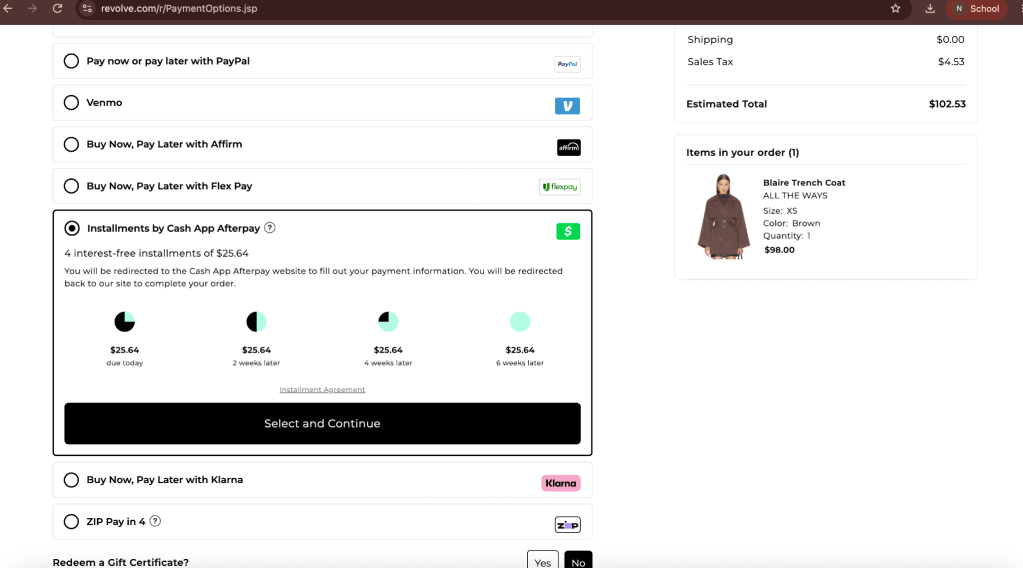
Screenshot of Checkout on Revolve Website, Installment Graphs of 4 interest-free installment using Afterpay or Klarna
BNPL can therefore increase conversion without a retailer lowering the list price. A discount reduces what the consumer pays; installment framing reduces what the purchase feels like at the moment of decision. Those are not the same benefits.
Revolve’s page also states that Klarna orders are subject to restrictions, that a credit check may occur depending on the service selected, and that a missed installment can lead to a late fee of up to $7. The page says Klarna adjusts installments after a return, but shoppers should still monitor both the retailer and lender until the refund is fully reflected. A returned dress and a scheduled debit can move on different timelines.
Klarna’s Convenience—and the Risk of “Loan Stacking”
Klarna makes borrowing feel integrated with shopping rather than separated from it. That smoothness is part of the appeal: approval, purchase, reminders, and repayment can happen in a few taps. But a frictionless experience can make it easier to open several small obligations without seeing them as one total.
Government researchers call this loan stacking—holding multiple BNPL loans at the same time, sometimes across different providers. A Consumer Financial Protection Bureau study found that in 2022 approximately 63% of BNPL borrowers originated simultaneous loans at some point, while 33% did so across multiple firms. Many of those loans did not appear in traditional credit records, making a shopper’s total obligations less visible to other lenders—and potentially to the shopper herself.
The CFPB’s 2025 market report found continued growth among the six companies it examined. Their users averaged 6.3 BNPL loans per lender in 2023, and the inflation-adjusted annual amount borrowed per user at each lender rose from $745 in 2022 to $848 in 2023. The report also found that late-fee incidence declined, an important reminder that the story is not simply one of universal consumer harm. Most individual loans may be repaid as agreed. The more subtle risk is losing sight of the combined calendar.
A shopper may remember the $60 due on her dress and forget the $32 shoes, the $45 bag, and the beauty order scheduled for the same Friday. “Interest-free” does not mean “cash-flow-free.”
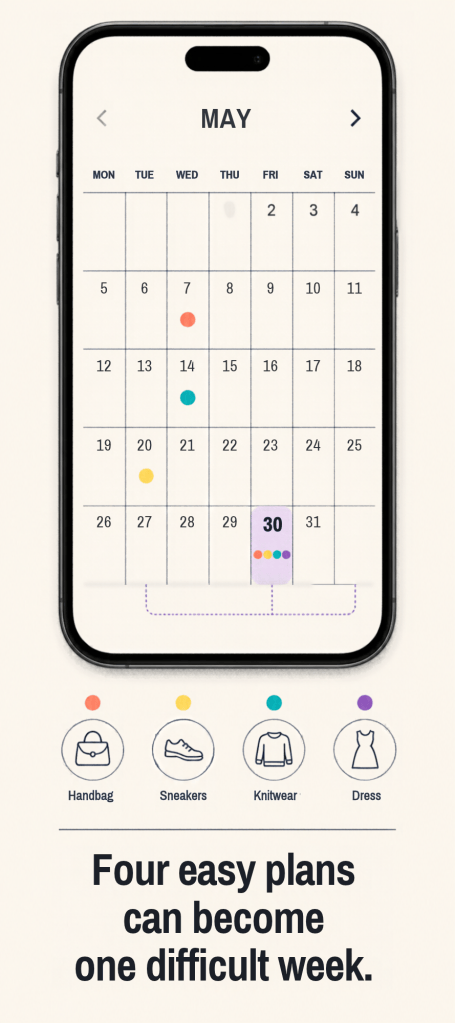
Graphic of iphone calendar showing each day one owes money due to the Buy Now, Pay Later option at checkout
What Governments Are Saying
U.S. agencies increasingly treat BNPL as credit, even when its marketing resembles a checkout convenience.
The Federal Trade Commission advises shoppers to investigate fees, credit reporting, return policies, and the consequences of missed payments before accepting a plan. It also warns that automatic withdrawals can trigger overdraft fees when a linked bank account lacks sufficient funds. In other words, a 0% BNPL plan could still create an indirect cost at your bank.
The federal regulatory picture has also shifted. In 2024, the CFPB issued an interpretation that would have treated certain BNPL providers like credit-card issuers for purposes including billing disputes and refunds. However, the agency withdrew that interpretive rule in May 2025. Consumers should not assume that every BNPL transaction automatically provides the same protections as a conventional credit card. The precise rights available can depend on the product, provider, contract, and state law.
States are beginning to fill parts of that gap. In 2025, New York enacted a framework for licensing and supervising BNPL providers. According to the New York Department of Financial Services, the framework is intended to require clearer disclosures, dispute-resolution standards, limits on charges and fees, and data-privacy protections. The direction of policy is clear: governments see value in payment flexibility, but they also recognize that small installment amounts can obscure meaningful credit risk.
The concern is not abstract. The Wall Street Journal reported that BNPL companies were asked to provide information about their lending practices, while The Daily has framed financing apps within the wider conversation about consumer debt. Public attention is moving from how easy BNPL is to use toward how well shoppers can understand and manage its cumulative cost.
A Smarter Fitting-Room Test for BNPL
BNPL is most useful when it follows a purchasing decision, not when it creates one. Before selecting Klarna, Afterpay, or another provider, try this five-part test:
- Start with the total. Say “This dress costs $240,” not “This dress costs $60.” If the full price feels wrong for your budget, dividing it does not correct the mismatch.
- Map every due date. Add all installments from every provider to one calendar. Include rent, subscriptions, credit-card payments, and ordinary expenses.
- Check the return route. Learn whether payments continue while a return is processed, how refunds are issued, and whom you must contact if the retailer and lender records disagree.
- Read beyond “interest-free.” Look for late fees, service fees, possible credit checks or reporting, overdraft exposure, and the APR on any longer-term option.
- Remove the urgency. Wait 24 hours for nonessential apparel. If the item still fits your wardrobe, your event, and your total budget tomorrow, BNPL may be a payment tool rather than a persuasion tool.
Graphic idea 4 — Saveable checklist: Create a vertical “BNPL Before You Buy” card sized for Pinterest and Instagram Stories. Use five icons: price tag, calendar, return arrow, document, and clock. This can double as a downloadable graphic and drive readers back to the article.
The Bottom Line
Buy now, pay later can expand access to women’s apparel, smooth the timing of a planned expense, and help a shopper avoid high credit-card interest when she repays on schedule. Those are real advantages. The danger begins when a smaller installment is mistaken for a smaller purchase.
For fashion consumers, the most protective habit is simple: shop in totals, budget in totals, and compare in totals. Let the four-payment schedule determine when you pay—not convince you what you can afford.
The dress is still $240. The clearest checkout is the one that helps you remember it.
References
Acree, N. R., Barnes, K., Bruce, A., & Hannon, S. M. (2026, June 5). “Buy now, pay later” beyond “pay in 4”: A comprehensive product overview. Board of Governors of the Federal Reserve System. https://www.federalreserve.gov/econres/notes/feds-notes/buy-now-pay-later-beyond-pay-in-4-a-comprehensive-product-overview-20260605.html
Ashby, R., Sharifi, S., Yao, J., & Ang, L. (2025). The influence of the buy-now-pay-later payment mode on consumer spending decisions. Journal of Retailing, 101(1), 103–119. https://www.sciencedirect.com/science/article/pii/S002243592500003X
Consumer Financial Protection Bureau. (2025, December 10). The buy now, pay later market. https://www.consumerfinance.gov/data-research/research-reports/the-buy-now-pay-later-market/
Federal Trade Commission. (2023, March). Buy now, pay later, rent-to-own, lease-to-own, and layaway. https://consumer.ftc.gov/articles/buy-now-pay-later-rent-own-lease-own-and-layaway
Guttman-Kenney, B., Firth, C., & Gathergood, J. (2023). Buy now, pay later (BNPL) … on your credit card. Journal of Behavioral and Experimental Finance, 37, Article 100788. https://www.sciencedirect.com/science/article/pii/S2214635023000023
Hamilton, K. (2025, December 1). Buy now, pay later companies asked to share lending practices. The Wall Street Journal. https://www.wsj.com/business/buy-now-pay-later-companies-asked-to-share-lending-practices-8b6cec8e
Klarna. (n.d.). Klarna. https://www.klarna.com/us/
Kumar, A., Salo, J., & Bezawada, R. (2024). The effects of buy now, pay later (BNPL) on customers’ online purchase behavior. Journal of Retailing, 100(4), 602–617. https://www.sciencedirect.com/science/article/pii/S0022435924000654
New York State Department of Financial Services. (2025, May 9). Governor Hochul signs new legislation to protect consumers and keep money in New Yorkers’ pockets as part of the FY 2026 budget. https://www.dfs.ny.gov/reports_and_publications/press_releases/pr20250509_2
Revolve. (n.d.). Buy now, pay later. https://www.revolve.com/content/lp/klarna/mobile/
The New York Times. (2026, September 8). ‘Buy now, pay later’: A new wave of consumer debt [Audio podcast episode]. In The Daily. https://www.nytimes.com/2026/09/08/podcasts/the-daily/consumer-debt-financing-apps.html?searchResultPosition=1






Leave a Reply