
Why using less water in denim finishing does not automatically mean cleaner wastewater.

A denim collection can save water and still leave an executive with unanswered questions about pollution. That is the challenge behind Levi’s wet-processing story: a compelling efficiency claim cannot, by itself, establish what leaves a supplier’s discharge pipe. For fashion leaders balancing product innovation, sourcing costs, and brand trust, the distinction deserves a place in the next collection review.
Levi’s Water<Less initiative illustrates the value of redesigning denim finishing. Its supplier controversy in Mexico illustrates why chemical management requires separate scrutiny. Together, these examples offer an executive lesson: evaluate water quantity, wastewater quality, and supply-chain accountability as connected responsibilities, each requiring its own evidence.

Wet processing: the business behind denim’s look
Wet processing includes water-based textile treatments such as cleaning, bleaching, dyeing, and finishing. In denim, these operations help create the color, softness, and worn appearance that customers recognize. The EPA’s overview of textile-mill processes and wastewater pollutants identifies dyeing, bleaching, rinsing, and special finishing among wastewater-generating activities (U.S. Environmental Protection Agency [EPA], n.d.).
For a product team, a distressed finish is a design decision. For a supplier, it is also a processing requirement. Executives should therefore ask how aesthetic specifications translate into water, chemical, and treatment demands. Sustainability decisions begin before the factory receives the purchase order.
Planet Tracker’s analysis of wet-processing water risk cites an estimated 430 liters of water per kilogram of fabric (Planet Tracker, 2020). This is a contextual estimate, not a universal denim benchmark or a verified figure for Levi’s. Its value is to prompt facility-specific questions rather than substitute for supplier measurements.
The issue also extends to energy. UNEP’s textile value-chain assessment identifies wet processing as a significant climate-impact stage (United Nations Environment Programme [UNEP], 2020). A water-efficient process still needs evaluation of energy demand and chemical performance.
What Levi’s Water<Less actually demonstrates
In its 2014 explanation of Water<Less denim finishing, Levi Strauss & Co. described techniques introduced in 2011 that could reduce finishing water use by up to 96% in some cases (Levi Strauss & Co., 2014). That qualification matters. The figure concerns particular finishing techniques, not an automatic 96% reduction across every garment’s entire life cycle.
Water-saving innovation deserves credit. It challenges the assumption that a familiar denim appearance always requires a familiar production recipe. For executives, however, the appropriate follow-up is whether the same process also changes chemical inputs, wastewater composition, treatment performance, and operating costs.
Those outcomes cannot be inferred from a water-saving percentage. Nor does a finishing claim explain cotton cultivation or consumer laundering. An accurate product story should preserve its boundaries: identify the stage improved, the comparison used, and the products covered. Specificity makes an environmental claim more useful to both purchasing teams and customers.
The 2012 supplier case: a separate pollution problem
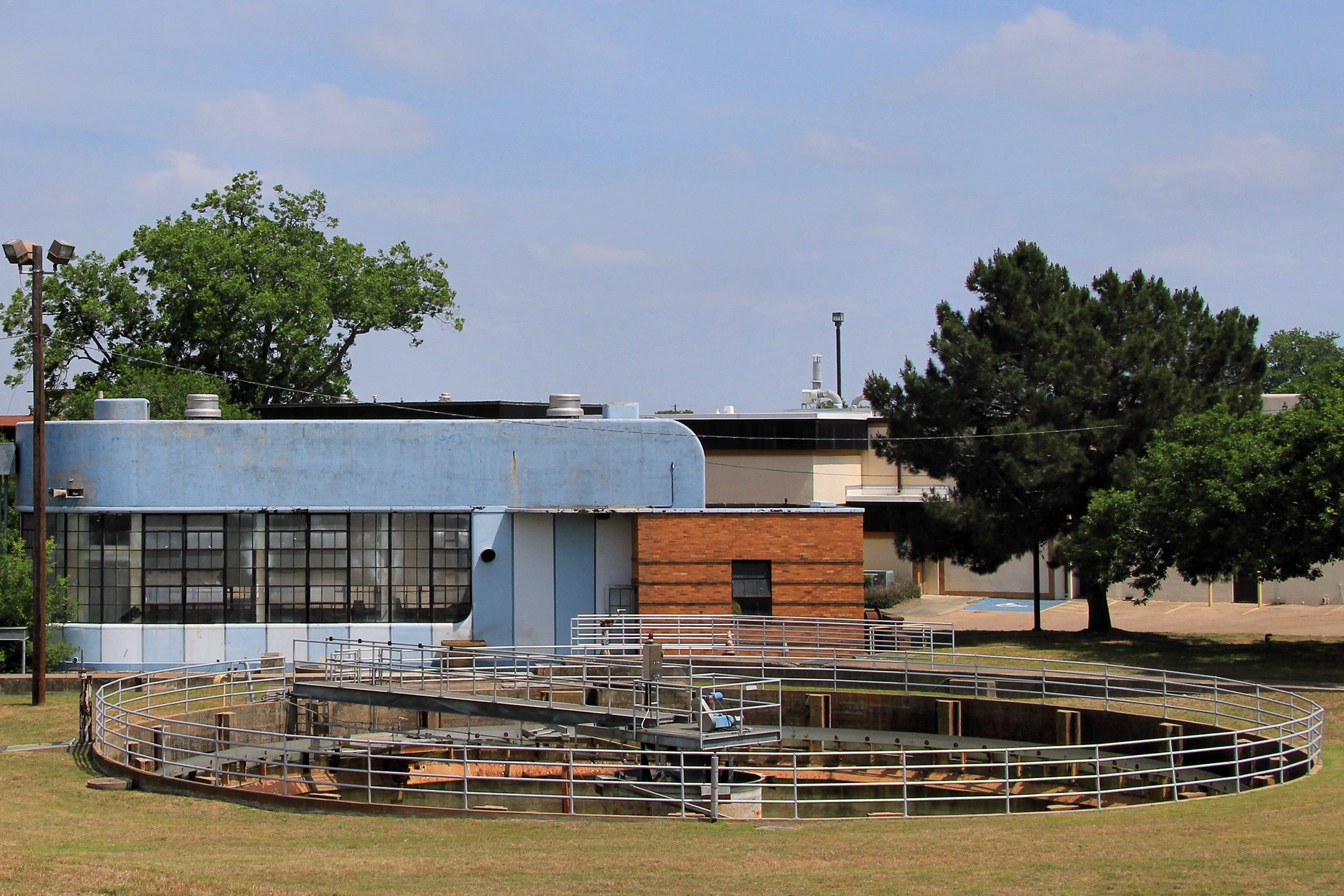
Greenpeace’s December 2012 report, Toxic Threads: Under Wraps, documenting Mexican textile-factory wastewater, reported hazardous substances in discharges from Lavamex in Aguascalientes and Kaltex in San Juan del Río. The report recorded Levi Strauss & Co.’s acknowledgment of sourcing relationships with both suppliers (Greenpeace International, 2012).
Findings included nonylphenol and nonylphenol ethoxylates at Lavamex, and other substances associated with textile processing. The report described nonylphenol’s persistence and hormone-disrupting properties. It also reported traces of certain phthalates at Kaltex while explicitly noting that non-textile sources could not be excluded. That caveat should remain part of any responsible account.
This investigation did not establish that Water<Less techniques caused the detected pollution. It also does not establish present-day conditions at those facilities. Its relevance is the historical coexistence of water-efficiency messaging and a separate supplier pollution concern.
For leadership, the question is how an organization validates environmental performance beyond its most marketable metric. A sourcing relationship creates a reason to investigate and act; it does not identify the brand responsible for every chemical detected in a shared factory’s discharge.
From activist pressure to a published response
The issue reached retail settings. In December 2012, Greenpeace reported activists placing warning labels on Levi’s products in 36 German cities and accused the company of greenwashing (Greenpeace e.V., 2012). This documents organized activist pressure, rather than proving a measurable decline in consumer demand or a legal finding against the brand.
Levi Strauss & Co.’s December 2012 chemical-management response and action plan said it strengthened commitments after engagement with Greenpeace. Announced measures included enhanced supplier training and auditing to enforce restrictions on alkylphenol ethoxylates, a planned phaseout of perfluorinated compounds, and a pilot for discharge transparency at 40 facilities. The company also described its participation in the Zero Discharge of Hazardous Chemicals roadmap (Levi Strauss & Co., 2012).
These were commitments, not evidence that every objective had already been achieved. Executives evaluating a response should distinguish a policy announcement from implementation, and implementation from verified environmental improvement. Each step needs an owner, a deadline, and a result that can be checked.
Why using less water does not guarantee cleaner wastewater
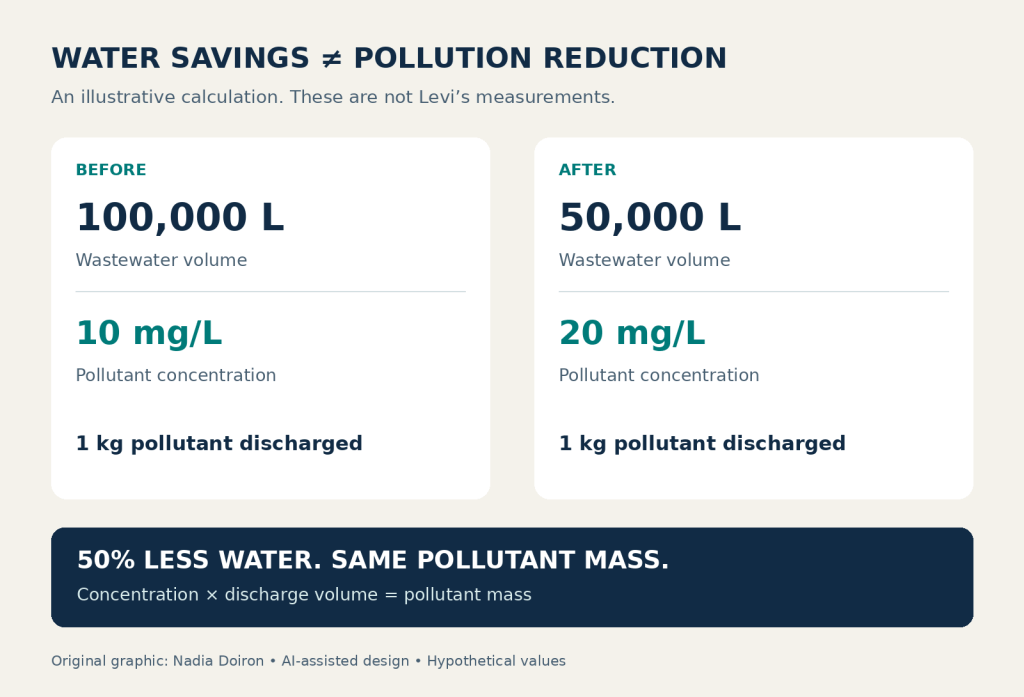
Three measurements answer different questions: water volume, pollutant concentration, and pollutant mass. Reducing water use can improve efficiency without reducing the amount of a particular pollutant generated. If the same pollutant mass enters less water, its concentration increases. This is a mathematical possibility, not a finding about Levi’s Water<Less facilities.
Consider a hypothetical discharge containing one kilogram of a pollutant in 100,000 liters of water: its concentration is 10 milligrams per liter. Halving the water volume while keeping the pollutant mass unchanged doubles concentration to 20 milligrams per liter. The water saving is real; the pollutant reduction is zero.
Conversely, dilution can lower concentration without lowering total pollutant mass. Executives should resist selecting whichever number produces the strongest headline. Concentration, flow volume, and total load provide complementary evidence, while the identity and hazard of each substance remain essential.
Wastewater color alone is also an inadequate scorecard. EPA’s textile overview includes oxygen-demand measures, suspended solids, and pH among regulated parameters, illustrating the need to examine more than appearance (EPA, n.d.).
Cleaner production needs better purchasing decisions
The governance challenge begins with visibility. A brand may know its garment assembler while having limited information about the mill or finishing laundry. Planet Tracker recommends extending disclosure beyond first-tier suppliers and financing improvements in wet-processing technology and treatment (Planet Tracker, 2020).
The OECD’s garment and footwear due-diligence guidance provides a framework for addressing adverse supply-chain impacts rather than treating supplier assessment as an isolated exercise (Organisation for Economic Co-operation and Development [OECD], 2018). Applied to denim, that means connecting environmental expectations with the commercial relationship.
My recommendation is to review whether prices, lead times, and order stability support the standards being demanded. A factory cannot budget for equipment maintenance or specialist staff using a sustainability pledge alone. Brands should negotiate improvement plans with suppliers and clarify who funds capital upgrades and recurring costs.
Leadership should also involve the people closest to production. Workers need suitable training and ways to report problems without retaliation. Nearby communities need understandable discharge information and channels to raise concerns. These are proposed safeguards, not claims about specific harms established by the 2012 investigation.
The aim is to prevent environmental costs from being pushed onto people with the least influence over the purchasing decision. Where a brand identifies harm, corrective action should include affected stakeholders and a way to evaluate whether the response works.
A wet-processing dashboard executives can use
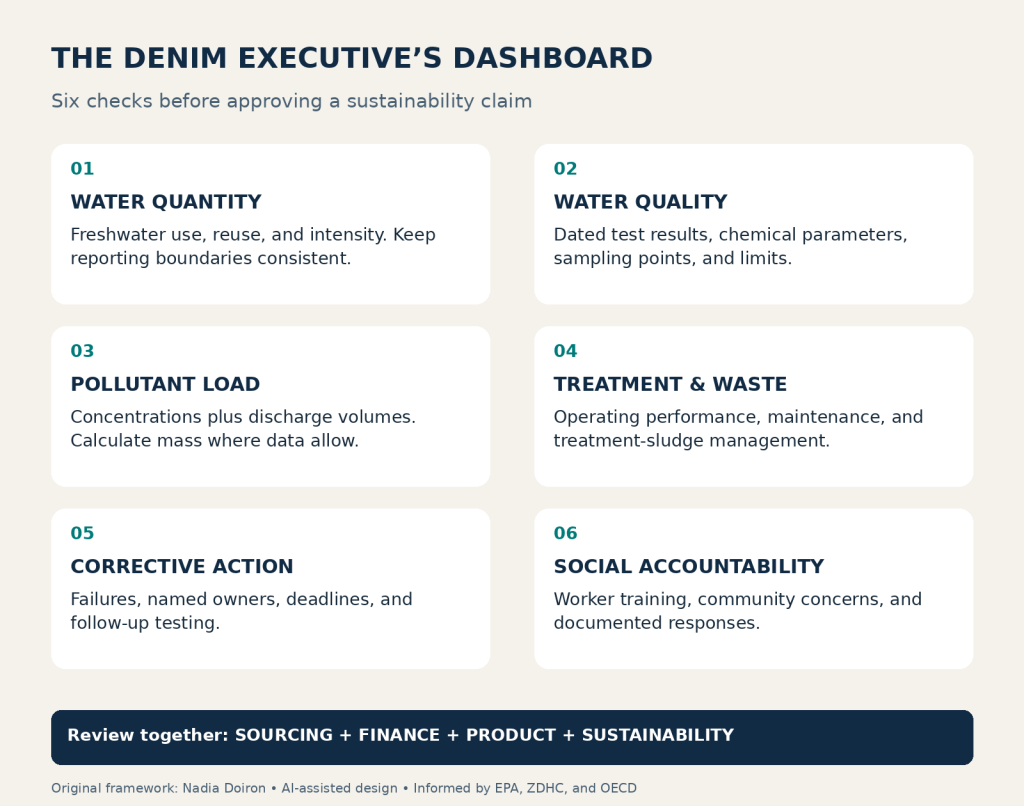
A practical review should combine operational data with evidence of follow-through. I recommend asking suppliers and internal teams for:
- Water quantity: freshwater withdrawals, water reused, and water use per kilogram or garment, with consistent boundaries.
- Water quality: dated wastewater results, relevant chemical parameters, sampling locations, and applicable limits.
- Pollutant load: measured concentrations alongside discharge volumes, where reliable calculations are possible.
- Treatment and waste: equipment performance, operating records, and the management of treatment sludge.
- Corrective action: failures, responsible owners, completion dates, and repeat testing after improvements.
- Social accountability: worker training, community concerns, and evidence that reported problems receive responses.
ZDHC’s wastewater and sludge guidance for wet-processing suppliers helps harmonize testing requirements across brands. Its scope includes dyeing, finishing, and laundry facilities. Importantly, the guidance states that conformance does not automatically guarantee legal compliance in a particular country (ZDHC Foundation, n.d.).
Use these tools alongside local requirements and facility-level investigation. A passing sample should inform oversight; it should not end it. Compare trends, explain missing data, and investigate whether reported improvements persist through different production conditions.
Track absolute impacts alongside efficiency. If water use per garment falls while production grows faster, total water demand can still rise. Likewise, a percentage of passing tests says little without the number of facilities covered and the parameters assessed. An executive dashboard should make those denominators visible and keep reporting boundaries stable between years. Otherwise, an apparent improvement may reflect a change in coverage rather than a change in environmental performance.
For investment decisions, compare equipment costs with ongoing operation, maintenance, training, and verification needs. The cheapest installation is not necessarily the most reliable system. Assign accountability across sourcing, finance, product development, and sustainability so that a facility’s improvement plan survives changes in personnel or seasonal purchasing priorities. Review progress before approving the next order cycle.
Make the marketing claim match the evidence
The commercial risk appears when a narrow improvement becomes a broad promise. The FTC’s guidance on environmental marketing claims cautions against unqualified claims such as “green” or “eco-friendly” and calls for clear, specific benefits (Federal Trade Commission [FTC], 2012).
For denim executives, the application is straightforward: explain the finishing improvement without implying that it proves pollution-free manufacturing. A claim should name its baseline, production stage, coverage, and evidence. Where wastewater results are available, present them separately with dates and scope.
This does not mean avoiding sustainability communication. It means giving customers and business partners information they can interpret correctly. A credible brand can explain progress and limitations in the same product story. That approach also gives merchandising, sourcing, and marketing teams a shared standard for approval.
The next collection review should ask two questions
Levi’s provides a useful case because innovation and scrutiny appear together. Water-saving techniques can improve denim production, while historical supplier findings show why chemical management and transparency deserve equal attention. Neither cancels the other.
Before approving the next sustainability campaign, fashion leaders should ask: How much freshwater did we avoid using, and what evidence shows we reduced harmful discharge? Then ask whether the purchasing decisions behind the collection support those outcomes. Responsible wet processing becomes credible when design choices, supplier investment, environmental measurements, and public claims tell the same story.
Tags: Wet processing · Sustainable denim · Levi’s · Wastewater · Water pollution · Supply-chain responsibility
References
Federal Trade Commission. (2012). Environmental claims: Summary of the Green Guides.
Greenpeace e.V. (2012, December 8). Greenpeace-Aktivisten kennzeichnen Levi’s-Produkte [Greenpeace activists label Levi’s products].
Greenpeace International. (2012, December). Toxic threads: Under wraps—Exposing the textile industry’s role in polluting Mexico’s rivers.
Levi Strauss & Co. (n.d.). Environmental initiatives—Sustainability in fashion. Levi’s. https://www.levi.com/US/en_US/blog/article/how-we-make-jeans-with-less-water
Levi Strauss & Co. (2014, March 21). World Water Day: Let’s make a difference, together.
Organisation for Economic Co-operation and Development. (2018). OECD due diligence guidance for responsible supply chains in the garment and footwear sector. OECD Publishing. https://doi.org/10.1787/9789264290587-en
Planet Tracker. (2020, December 14). Wet processing is weak link in “greening” fashion supply chains, says Planet Tracker.
United Nations Environment Programme. (2020, October 1). Sustainability and circularity in the textile value chain: Global stocktaking.
U.S. Environmental Protection Agency. (n.d.). Textile mills effluent guidelines.
ZDHC Foundation. (n.d.). Wastewater is tested and managed in accordance with the ZDHC wastewater and sludge guidelines.
Photography credits
Andreiflorea993. (2026, April 13). Close-up of denim fabric [Photograph]. Wikimedia Commons. CC BY-SA 4.0.
Moore, L. D. (2014, May 7). Govalle wastewater plant Austin TX 2014 [Photograph]. Wikimedia Commons. CC BY 4.0.
Levi Denim (n.d.). Levi Women Jeans. Levi’s. Levi (n.d.). Levi Jeans. https://www.Levi.com/US/En_US/Clothing/Women/Jeans/Loose-Baggy-Jeans/Cinch-Wide-Leg-Womens-Jeans/p/0073B0001?Srsltid=AU7gw4U4vDFXW2iXiVHe3JZNxHMt42lIc7JjK8KXABR7ddHKiQ_-EKgG.







Leave a Reply