Inside Ghana’s Kantamanto Market, secondhand fashion creates jobs and extends clothing life—but low-quality imports leave traders and communities carrying fashion’s waste.
By Nadia Doiron | The Nadia Edit
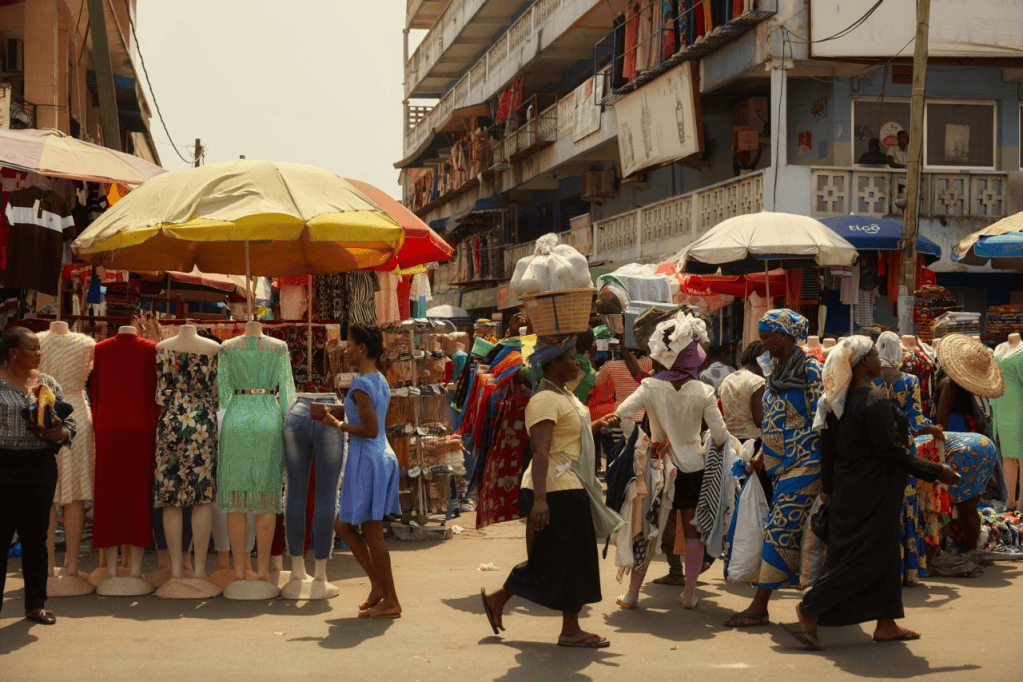
Kantamanto is both a major reuse economy and a frontline of the global fashion-waste crisis. Photograph from Atmos
We tend to imagine donating clothes as a clean ending. We clear space in our closets, tie up a bag, drop it into a collection bin, and feel that someone else will give our clothing a second life. The gesture feels responsible, especially compared with throwing a garment into the trash. But the life of that donated T-shirt, dress, or pair of jeans may be much more complicated than the story we tell ourselves.
Some of those garments travel thousands of miles to Accra, Ghana, where Kantamanto Market has become one of the world’s largest centers for secondhand clothing. There, traders, tailors, dyers, cleaners, porters, and upcyclers perform the difficult work that turns unwanted clothing back into desirable fashion. The market is an extraordinary example of creativity and circularity. It is also a place where the global fashion industry’s definition of “reuse” begins to fall apart.
When clothing arrives damaged, stained, poorly constructed, or inappropriate for the local market, it does not magically become sustainable because it crosses a border under the label of secondhand goods. Instead, Ghanaian traders absorb the financial loss, and Accra’s communities and waste systems inherit the material itself. My argument is not that secondhand fashion is the problem. The problem is a global system that exports clothing without exporting responsibility.
Kantamanto Market Is More Than Fashion’s Dumping Ground
Kantamanto is sometimes shown to Western audiences only through dramatic photographs of textile waste. That framing may attract attention, but it leaves out the people and labor that keep clothing in circulation.
The Or Foundation’s research on Kantamanto’s reuse economy estimates that approximately 30,000 people work within the market. Clothing is sorted, cleaned, repaired, ironed, dyed, tailored, screen-printed, styled, and resold. The organization reports that workers recirculate roughly 25 million garments per month—circular-fashion labor on a scale that many highly promoted resale platforms have not achieved.
Imported secondhand clothing is often called obroni w’awu, an Akan expression commonly translated as “dead white person’s clothes.” The phrase reflects an older assumption that someone would have to die to give up so many usable possessions. Today, however, constant trend cycles, low prices, influencer hauls, and one-click shopping make clothing disposable long before it is physically worn out.
Researchers Lydia Ayorkor Manieson and Tiziana Ferrero-Regis describe a revealing contradiction in their study of the secondhand trade in Kantamanto. Ghanaian workers restore the economic and cultural value that clothing lost in the Global North. At the same time, the trade can reproduce inequality when exporting countries send low-grade garments and leave importing communities to manage the waste.
Kantamanto, then, is neither simply a landfill nor a perfect circular-fashion success story. It is a working marketplace caught between reuse and disposal—and that complexity matters.
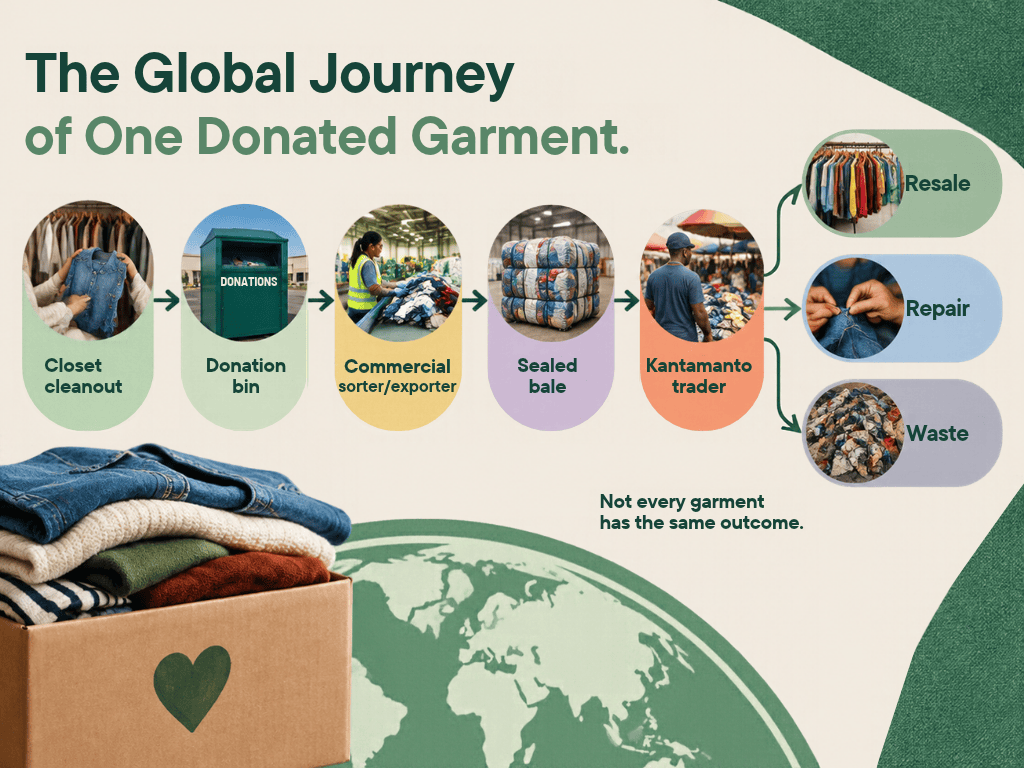
Flowchart tracing a donated garment from a Western closet to resale, repair, or disposal in Ghana graphic created by TheNadiaEdit, 2026 using CANVA AI
The Hidden Risk Inside a Sealed Bale
The business risk of the secondhand trade is not shared equally. Kantamanto traders often buy tightly packed bales of clothing without being able to inspect every item first. A bale might contain desirable denim, event dresses, or recognizable labels. It might also contain torn, stained, stretched, or weather-inappropriate clothing that cannot be sold at a price high enough to recover the trader’s investment.
This is an information problem with real financial consequences. A 2026 research project on quality uncertainty in Ghana’s clothing market describes the cost borne by traders as an “uncertainty tax.” Exporters and suppliers know more about the clothing than the person purchasing the bale, yet the buyer carries the loss when its contents are poor.
That detail changes the ethics of the supply chain. The trader in Accra did not design an ultra-thin polyester top, choose weak stitching, or encourage a consumer to treat it as disposable. Still, that trader may become the person expected to find value in it—or pay to remove it.
For fashion executives, this should sound familiar. Brands routinely use quality control, supplier standards, inspections, and traceability to reduce uncertainty before new merchandise reaches a store. The secondhand export chain deserves similar expectations. Quality standards should not disappear simply because a garment has already had one owner.
How Much Clothing Becomes Waste? The Number Is Contested
One of the most repeated claims about Kantamanto is that roughly 40% of the clothing passing through the market becomes waste. That estimate comes from the Or Foundation’s years of surveys, interviews, observation, and garment-sorting research. It has helped draw international attention to the volume of low-quality clothing arriving in Accra.
However, industry groups dispute that figure. A 2024 report associated with the Ghana Used Clothing Dealers Association estimated that up to 5% of imported bale contents is waste. These figures do not necessarily measure the same stage of a garment’s life. “Immediate waste inside a bale” is different from clothing that is initially sold at a low price but discarded after a short period. Definitions of waste, reuse, downcycling, and final disposal can also change the result.
Rather than choosing the statistic that creates the most dramatic headline, fashion professionals should recognize what the disagreement reveals: the international secondhand trade lacks reliable, independent, shared tracking. Even the European Environment Agency’s analysis of used-textile exports warns that trade classifications do not always distinguish genuinely reusable clothing from textile waste. Exporters may also lose visibility once garments pass through multiple countries and intermediaries.
If the fashion industry can track a new handbag from factory to fulfillment center, it should be able to track what happens to garments collected under sustainability campaigns.
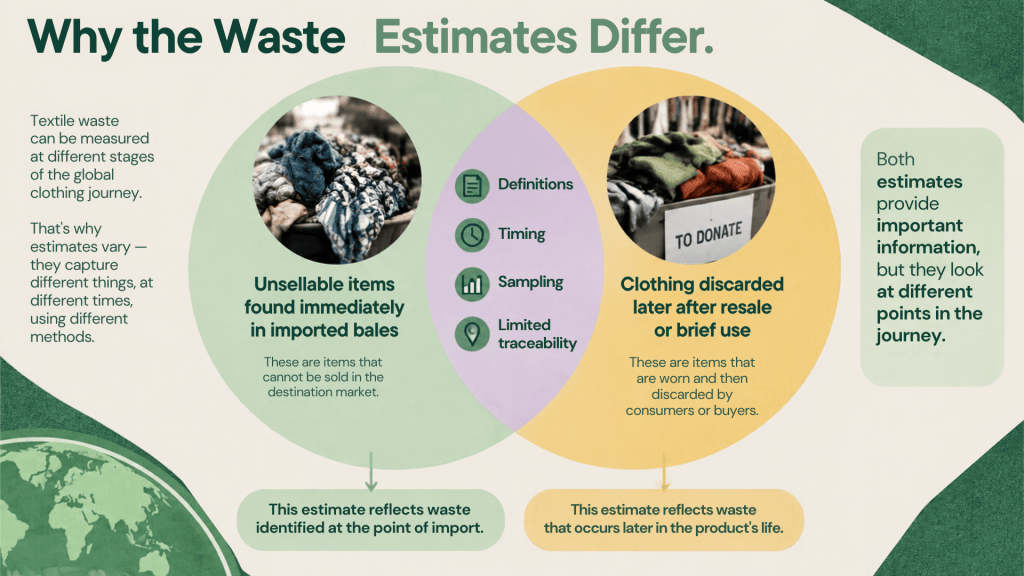
Diagram explaining why estimates of secondhand clothing waste in Ghana range from about 5 to 40 percent. Graphic created by Nadia Doiron using CANVA AI for The Nadia Edit, 2026.
When Fashion Waste Reaches the Water
The consequences extend beyond a cluttered market. Clothing that cannot be sold or processed may enter dumpsites, drains, beaches, and waterways, including the Korle Lagoon. Accra’s waste infrastructure must then handle material originally manufactured and consumed elsewhere.
Synthetic fibers make the issue even more persistent. Polyester, nylon, and acrylic are forms of plastic, so a garment can fragment without truly disappearing. A 2026 citizen-science study by Dimitri Deheyn, Joe Ayesu, and Branson Skinner found high concentrations of synthetic microfibers and small microplastics around Kantamanto. The researchers examined airborne particles, rainwater, lagoon water, discarded garments, and clothing found on nearby beaches. Their findings connect the visible problem of unwanted garments with a less visible form of pollution.
This does not mean every microfiber in Accra comes from imported secondhand clothes, nor should one study be stretched beyond its evidence. It does mean that fiber choice and garment quality remain relevant after the original customer is finished with a product. A polyester garment sold cheaply in one country can create environmental costs far beyond its first closet.
For readers who followed The Nadia Edit’s discussion of material claims in vegan leather, the lesson is similar: a compassionate or sustainable-sounding label does not replace a full material-life-cycle analysis. “Vegan,” “recycled,” “donated,” and “secondhand” describe one feature of a product or transaction; none automatically guarantees a responsible outcome.
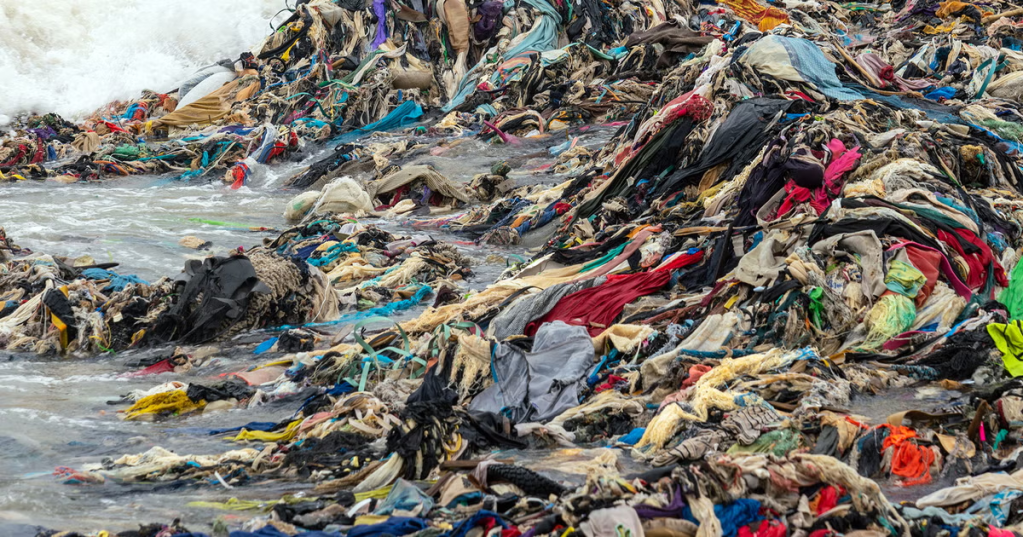
Low-quality synthetic clothing can create both visible waste and less visible microfiber pollution. Photograph from Independent.Co
Donation Is Not the Same as Direct Aid
Many consumers believe the clothing placed in a donation bin will be handed directly to a person who needs it. Some items are distributed locally, but many enter a commercial resale system. Collection organizations may sell excess clothing to sorters, who grade and export it. Importers purchase the clothing, and local traders buy bales to resell individual pieces.
That commerce is not automatically unethical. Resale supports livelihoods and gives consumers access to affordable fashion. The ethical problem begins when unusable goods are described as charitable donations or reusable products, allowing exporters to receive the value while someone else inherits the disposal cost.
Consumers deserve clearer information from charities, take-back programs, and retailers: What percentage is resold locally? What is exported? How is quality assessed? What happens to items that cannot be worn again? A recycling box placed beside a register should not function as a marketing prop.
Why Banning Secondhand Clothing Is Not a Complete Solution
It would be easy to conclude that Ghana should simply ban used-clothing imports. That response ignores the market’s economic importance and the needs of consumers who rely on affordable apparel. It could also punish traders for a problem created much earlier in the fashion system.
The aftermath of the January 2025 Kantamanto fire illustrates how vulnerable this workforce already is. A Ghana News Agency report one year after the fire found that traders had rebuilt and returned, but business had not fully recovered. Many of the people affected were women, and the disruption reached the broader used-clothing supply chain.
The goal should not be to erase Kantamanto. It should be to strengthen the people who make reuse possible while stopping exporters from treating Ghana as the final answer to overproduction.
What Fashion Executives Should Do Next
Fashion brands, resale companies, charities, exporters, and policymakers all have roles to play. A more responsible system would:
- establish enforceable quality standards separating reusable garments from waste before export;
- publish destination and outcome data for retailer take-back and donation programs;
- design clothing for durability, repair, fiber recovery, and longer use;
- reduce overproduction instead of depending on donation channels to absorb unsold or unwanted goods;
- offer bale-level quality information or guarantees so traders do not carry all the risk;
- invest directly in Ghanaian sorting, repair, recycling, and waste-management infrastructure; and include Kantamanto’s traders, upcyclers, and local organizations in policy decisions.
Extended producer responsibility, usually called EPR, could help move these ideas from voluntary promises to financial accountability. Under EPR, producers contribute to the costs of collecting, sorting, recycling, or disposing of products after use. The Ellen MacArthur Foundation’s Ghana textile-policy factsheet notes that Ghana has been developing an EPR framework for plastics with the possibility of expanding it to textiles and other categories. The United Nations Office for Sustainable Development has also worked with Ghanaian officials to examine textile-waste systems and circular-economy tools.
EPR cannot solve overconsumption by itself. Poorly designed fees can become another cost passed down the chain. A fair model must direct meaningful funding toward the communities doing the sorting, reuse, and cleanup—not only toward administrative programs in producer countries.
A Garment’s Second Life Still Has an Ending
Kantamanto reveals an uncomfortable truth about circular fashion: extending a garment’s life is valuable, but postponing disposal is not the same as preventing it. Ghanaian workers are performing some of the fashion industry’s most impressive reuse and repair labor. They should not also be expected to absorb unlimited quantities of low-quality clothing at their own financial and environmental expense.
The next time we clean out our closets, we should still donate wearable clothing—but with better questions. Is the item clean, durable, and genuinely useful? Does the collection program explain where clothing goes? Could we repair, resell, swap, or wear it longer before passing it on? Most importantly, are we using donation as a reason to buy more?
For executives, the question is even more direct: if your company profits from putting a garment into the world, where does your responsibility end?
The Nadia Edit challenge: Before your next closet cleanout, choose five garments and trace the most responsible next step for each—rewear, repair, resell, swap, recycle, or donate. Then ask your favorite fashion brand to publish what happens to every item collected through its take-back program. A second life should not mean an invisible ending.
References
Acquaye, R., Seidu, R. K., Eghan, B., & Fobiri, G. K. (2023). Consumer attitude and disposal behaviour to second-hand clothing in Ghana. Scientific African, 21, e01887. https://doi.org/10.1016/j.sciaf.2023.e01887
Associated Press. (2024, November 23). As fast fashion’s waste pollutes Africa’s environment, designers in Ghana are finding a solution. https://apnews.com/article/0809f25605722a53658bf21d7d9b1548
Deheyn, D. D., Ayesu, J., & Skinner, B. (2026). Small microplastics and microfibers found in high concentrations around Kantamanto, the world’s largest secondhand textile market in Accra, Ghana: A citizen science study. Environmental Advances, 24, 100711. https://doi.org/10.1016/j.envadv.2026.100711
Ellen MacArthur Foundation. (2024, September 25). Pushing the boundaries of EPR policy for textiles: Ghana factsheet. https://www.ellenmacarthurfoundation.org/epr-for-textiles-in-ghana
European Environment Agency. (2023). EU exports of used textiles in Europe’s circular economy. https://www.eea.europa.eu/en/analysis/publications/eu-exports-of-used-textiles
Ghana News Agency. (2026, January 7). One year after fire: Kantamanto traders lament decline in business. https://gna.org.gh/2026/01/one-year-after-fire-kantamanto-traders-lament-decline-in-business/
Lambon-Quayefio, M. (2026). Waste and quality uncertainty in imported secondhand clothing markets. Growth Research Platform. https://grp.cepr.org/pedl/projects/waste-and-quality-uncertainty-imported-secondhand-clothing-markets
Manieson, L. A., & Ferrero-Regis, T. (2023). Castoff from the West, pearls in Kantamanto? A critique of second-hand clothes trade. Journal of Industrial Ecology, 27(3), 811–821. https://doi.org/10.1111/jiec.13238
Okyere, E. Y. (2026). Evaluating Ghana’s environmental policy landscape on textile and microfibre pollution: A dual framework analysis. Nexus Research, 101963. https://doi.org/10.1016/j.nexres.2026.101963
The Or Foundation. (n.d.). Dead white man’s clothes. https://theor.org/work/dead-white-mans-clothes
United Nations Office for Sustainable Development. (n.d.). Supporting waste management and circular economy efforts in Ghana. https://unosd.un.org/en/events/story-impact-3-supporting-waste-management-and-circular-economy-efforts-ghana






Leave a Reply